If you’ve ever been on-site during a generator commissioning, UPS maintenance, or substation load test, you know that a high voltage load bank isn’t just a box that pulls power—it’s the backbone of proving that critical electrical equipment will perform when it matters most. As someone who’s been supplying high voltage load banks for over a decade, I’ve seen first-hand how skipping proper performance testing can lead to catastrophic failures when a data center, hospital, or remote mine relies on backup power. This isn’t about generic load testing; this is about testing high voltage units—those 4.16kV, 13.8kV, even 34.5kV beasts that handle megawatts of power—that demand precise, safety-focused, and technically rigorous testing. Let’s walk through exactly how we test the performance of our high voltage load banks, and the key steps that make the difference between a unit that works and one that performs reliably for decades. High Voltage Load Bank

First, before we even hook a single cable to a high voltage load bank, we have to ground every step in pre-test safety and calibration. High voltage equipment doesn’t mess around—one wrong connection, one uncalibrated sensor, and you’re looking at downtime, damaged gear, or worse. My team and I start with what we call “the pre-test triad” for every unit we manufacture, no exceptions. First, we verify all primary and secondary circuit calibrations using a NIST-traceable power analyzer. For low voltage load banks, you might get away with off-the-shelf multimeters, but for high voltage units, even a 0.5% calibration error can lead to invalid test results—like thinking your generator is underperforming when it’s actually the load bank’s voltage reading that’s off. Last year, we had a customer who brought in a competitor’s load bank for testing and found their voltage measurements were 2.2% inaccurate; that unit had been used to test 10MW generators, leading to unnecessary component replacements and $120k in lost production for their client. We never let that happen to our equipment, which is why every voltage tap and current sensor on our units is tested against a NIST traceable standard before it leaves our warehouse.
The second part of pre-test is a full mechanical and electrical insulation check. High voltage load banks have thick, insulated busbars, air or liquid-cooled resistors, and heavy-duty contactors that switch megawatts of power in milliseconds. We run a hipot test—a dielectric strength test—across every insulated component to make sure there are no hidden gaps or damaged insulation that could cause arcing during load testing. For outdoor high voltage units, which are common for remote site testing, we also test the enclosure’s NEMA rating and seal integrity, because a single drop of rain on an uninsulated busbar can take a unit offline mid-test. Last summer, a client of ours rented a cheap portable load bank for a substation test in rural Wyoming and had an insulation fault when a sudden thunderstorm rolled through; we now include a full insulation validation as part of every delivery, whether it’s a unit for on-site testing or permanent installation at a facility. The third pre-test step is a control system check. Our high voltage load banks use PLC-based control systems that connect remotely to test equipment, so we run through every control function—load step adjustment, voltage and frequency regulation, over-temperature shutdown, emergency stop—10 times in our lab before shipment. We even simulate signal drops to make sure the load bank doesn’t spike power if the control link is interrupted.
Once pre-test is complete, we move to what I call “baseline performance testing,” the core of how we measure a high voltage load bank’s real-world capabilities. Most people think load testing just means dumping power, but high voltage units need to prove they can handle dynamic loads, steady-state conditions, and variable power factors—all of which matter for realistic equipment testing. First, we do steady-state load testing at the unit’s rated capacity. For example, if we’re building a 15MW, 13.8kV load bank, we run it at 100% capacity for 4 hours straight, measuring voltage regulation, current distortion, and resistor surface temperature every 15 minutes. Resistors are the heart of a load bank, and many manufacturers cut corners here by using low-grade resistors that overheat and degrade performance after a few uses. We use custom-designed, cast-iron resistors with integrated cooling channels, and during baseline testing, we check that the resistor temperature never exceeds 120°C at full load—any higher, and you risk premature resistor failure. Last year, we had a client who reported that their load bank’s resistors failed after 2 years of semi-annual testing; when they sent in the old unit for inspection, we found their resistors had been running at 145°C, shortening their lifespan by 50% or more. Our baseline testing ensures our units stay within temperature limits, no matter how long they run.
Next, we test dynamic load response. Critical applications like data centers and healthcare facilities often need backup generators that can handle sudden load changes—like when a server room kicks on 5MW of load in 10 seconds. Our high voltage load banks are designed to replicate these sudden changes, so we simulate step loads: from 0% to 50% in 2 seconds, 50% to 100% in another 2 seconds, and even back down to 0% in 1 second. During these tests, we measure the load bank’s ability to track the target load within a 1% tolerance and the response time of its contactors. A slow response time here can mean the generator’s voltage spikes or dips beyond acceptable limits, damaging sensitive electronics. For example, a hospital’s emergency generator can’t have a voltage dip that causes critical life support systems to reset, so our dynamic load testing ensures our units can handle even the most rapid load changes required for healthcare facility testing.
Another key part of baseline testing is power factor (PF) testing. High voltage equipment operates at varying power factors, from 0.8 lagging to 1.0 (resistive) to even leading for inverter-based equipment like UPS systems. Many standard load banks only handle resistive loads, but our units are designed with adjustable inductive and capacitive banks to replicate any power factor from 0.7 leading to 0.95 lagging. During baseline testing, we adjust the PF across the full range, measuring the unit’s ability to maintain its rated load and voltage regulation at each setting. This is especially important for testing inverter-based generators and UPS systems, which often require non-resistive loads to validate their performance correctly. I’ve seen too many engineers get false test results because they used a resistive-only load bank to test an inverter UPS, leading them to think the UPS was underperforming when the load bank couldn’t replicate the actual operating conditions. Our power factor testing eliminates that risk.
Once baseline testing is done, we move to environmental and durability testing, because a load bank that works in our climate-controlled lab might not hold up in a desert mine or a sub-zero remote power station. For our high voltage load banks, we test performance across extreme temperature ranges: from -40°C to 55°C, which covers almost every on-site environment our clients work in. We run the unit at full load in a temperature chamber to make sure the cooling system works properly, the control system doesn’t glitch in cold weather, and the resistors maintain their rated power output. For outdoor units, we also test dust and water resistance per IP55 standards, simulating heavy rain and dusty conditions to ensure the unit doesn’t suffer performance degradation after extended exposure. Last year, we delivered a 20MW, 34.5kV load bank to a mining operation in northern Canada; our environmental testing meant that during the entire 72-hour generator commissioning test, the unit operated without a single glitch, even when temperatures dropped to -32°C. The mine’s project manager told us that a competitor’s unit had failed mid-test at the same site two years earlier, costing them $200k in lost production. That’s the difference proper environmental testing makes for high voltage load banks.
We also test for compliance with industry standards, because high voltage equipment has to meet strict safety and performance regulations. Our load banks are tested to IEEE standards, specifically IEEE 115 for synchronous generators and IEEE 120 for UPS systems, as well as OSHA safety standards for electrical equipment. We keep full test reports for every unit, including calibration data, insulation test results, and performance test curves, which we provide to our clients with every delivery. When a client is testing a generator for a data center, they need to be able to prove that the load bank used met industry standards for regulatory compliance, and those reports are often required for certifications. I can’t tell you how many times a client has come to us with a rejected test report because their previous load bank didn’t meet IEEE standards; that’s a mistake we eliminate with our thorough testing process.
Another step in our performance testing is long-term reliability testing, which is often overlooked by smaller load bank manufacturers. We run select production units for 72 hours straight at full load, simulating continuous operation that a unit might see at a permanent installation site. During this test, we monitor every parameter: voltage, current, temperature, fan speed, contactor operation, and control system performance, 24 hours a day. We’ve found that small issues—like a loose cooling fan connector or a minor control system lag—only show up after extended operation, and our long-term reliability testing catches these before a unit is delivered. Last quarter, we found a minor software glitch in a batch of load bank control systems during 72-hour testing; we fixed the glitch for all units in the batch before they were shipped, saving our clients from downtime during their first major test. That’s the kind of attention to detail that comes from testing high voltage load banks the right way, not just the fast way.
Finally, before a unit leaves our warehouse, we do a final on-waive test that replicates exactly what our clients will see on-site. We connect the unit to a simulated high voltage power source (often a portable generator or a utility transformer in our test yard) and run a full load test at the unit’s rated voltage and frequency. We verify all control functions, safety shutdowns, and data logging capabilities to make sure everything works as intended. We also provide a detailed test package to our clients, including all test data, operation manuals, and safety protocols, so they feel confident using the unit the day it arrives.
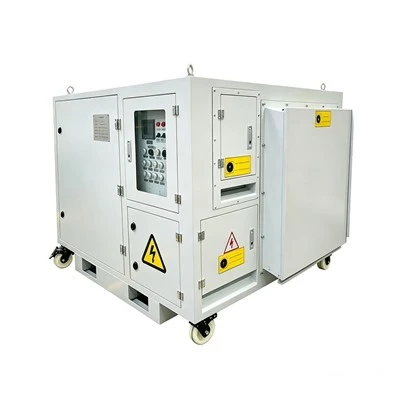
At the end of the day, a high voltage load bank is only as good as its performance testing. When you’re relying on a unit to test multi-megawatt generators, critical UPS systems, or substation equipment, you can’t cut corners on testing. As a high voltage load bank supplier, our reputation depends on delivering units that perform when they matter, whether that’s a critical commissioning test for a new data center or a maintenance test for a hospital’s emergency power system. If you’re in the market for a high voltage load bank, and you want to make sure it meets your performance requirements, let’s connect to discuss your specific needs. We work with clients across industries, from data centers and healthcare to mining and utilities, and we can help you select the right unit, provide the necessary test documentation, and support you throughout your testing process.
High Voltage Load Bank REFERENCES
IEEE 115-2019, IEEE Guide for Testing Synchronous Generator Units
IEEE 120-2019, IEEE Recommended Practice for Static Uninterruptible Power System (UPS) Testing
OSHA 29 CFR 1910, Occupational Safety and Health Standards for General Industry
Hebei Kaixiang Electrical Technology Co., Ltd.
Hebei Kaixiang Electrical Technology Co., Ltd. is one of the most professional high voltage load bank manufacturers and suppliers in China, featured by quality products and good price. Please rest assured to wholesale advanced high voltage load bank for sale here and get quotation from our factory. We also accept customized orders.
Address: No79 Wangshan Road,Luquan District, Shijiazhuang, Hebei, China
E-mail: triumphload@kxload.com
WebSite: https://www.triumphload.com/
