If you’re working in data centers, corporate office spaces, or industrial facilities, you’ve probably heard the terms “load class 1250” and “load class 2000” thrown around when talking about access floor panels. As someone who’s been supplying access floor panels for over a decade, I can tell you these numbers aren’t just random ratings—they’re the backbone of what makes a panel fit for a specific job. Many clients come to me confused about which one they need, so I want to break down the key differences clearly, based on years of field installations and customer feedback. Access Floor Panel

First, let’s start with the basics: load class ratings for access floor panels measure how much weight a single panel can support without deflecting or failing. Deflection is a big deal here—most industry standards say a panel shouldn’t deflect more than 2 millimeters under load, because too much movement can damage cables, servers, or other equipment sitting on top. Now, the numbers 1250 and 2000 refer to pounds per square foot (psf) of uniform load capacity. That means a load class 1250 panel supports 1,250 psf, and load class 2000 supports 2,000 psf. Wait, some people mix this up with point loads, but uniform load is the standard for everyday use—point load is a separate rating, but we’ll focus on uniform since that’s what’s used to assign these classes.
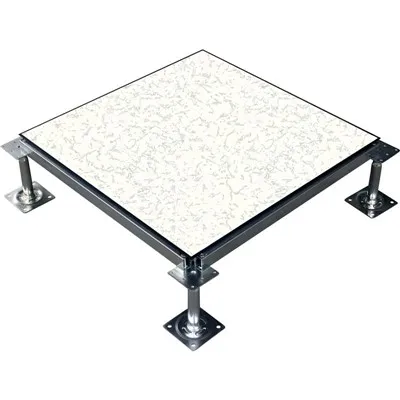
Let’s talk about construction, because that’s where the difference really shows. Load class 1250 panels are typically designed for lighter-duty applications. Most of these have a steel core, but it’s thinner than what you’d find in a 2000 panel. The surface is often a high-pressure laminate (HPL) or vinyl, which is durable enough for office chairs, foot traffic, and standard equipment racks, but not heavy industrial gear. The stringers—the metal supports along the edges of the panel—are smaller and lighter too, since they don’t need to hold as much weight. I’ve seen these installed in small office server closets, mid-sized corporate offices, and retail spaces where the only heavy stuff is a handful of network switches. For example, when we did a project for a marketing agency last year, they went with 1250 panels because their server closet only had two small racks and lots of walk space. They saved money without worrying about overcapacity.
On the flip side, load class 2000 panels are built for heavy-duty use. Their steel core is thicker, so it can bend less when under pressure. The stringers are heavier gauge steel, welded stronger, and some models even have additional cross-supports in the middle to distribute weight evenly. The surface is usually a cementitious tile, ceramic, or textured steel—material that can handle the weight of large server racks, forklifts (if you’re working in a warehouse), or even maintenance equipment rolling over it. A lot of our data center clients choose 2000 panels because server racks alone can weigh 1,500 psf or more, and you need extra capacity for when you add new racks later. Last year, we supplied 2000 panels to a cloud provider expanding their Chicago facility—they told me their old 1250 panels were starting to warp when they added a third rack, so the upgrade to 2000 prevented future issues.
Next, let’s dive into deflection, since that’s the critical performance metric. Like I said earlier, a good access floor panel should deflect no more than 2mm under load. Under a 1,250 psf load, a load class 1250 panel might deflect around 1.8mm, which is well within the safe limit. But if you put a 2,000 psf load on it, that deflection jumps to nearly 3mm—way over the industry threshold, and that’s when you start getting problems: loose cable connections, servers misaligning, even cracks in the panel surface. Load class 2000 panels, though, only deflect about 1.7mm under 2,000 psf, so they stay stable even with heavy equipment. I learned this the hard way early in my career—we once supplied 1250 panels to a small co-working space that decided to add a bank of 4 server racks. The first week, one panel warped so bad that the network cable running under it got pinched, taking down half the office’s Wi-Fi. We had to replace them with 2000 panels, and since then, I always advise clients to double-check their peak load, not just their current setup.
Cost is another big difference, and it makes sense when you look at the materials. Load class 1250 panels are cheaper to manufacture because they use less steel and lighter materials. That means for a project with a tight budget, they’re a solid choice if the load requirements are low. But if you go with 1250 panels in a heavy-duty space, you’ll end up paying more in the long run when you have to replace or repair damaged panels. Load class 2000 panels cost 20-30% more upfront, but they last longer and require less maintenance. For example, a data center might spend $5 per square foot on 1250 panels, but $7 per square foot on 2000. But if the data center expands and needs to add more racks, they don’t have to redo the access floor, which saves them tens of thousands of dollars in labor and downtime.
Installation and handling also differ. Load class 1250 panels are lighter, so two people can easily lift and install them—perfect for small spaces where you don’t have a lot of room to maneuver. Load class 2000 panels are heavier (each can weigh 50-60 pounds, compared to 30-40 pounds for 1250), so you might need a forklift or a team of three to move them, especially in large facilities. This is something clients often overlook: if your site has narrow hallways or tight storage, a 2000 panel might not be feasible, even if you need the load capacity. I had a client last year with a server room that only had a 3-foot door frame—they needed 2000 panels, but couldn’t lift them through the door, so we had to modify the doorway and use two extra workers to get them in. It added a small cost, but it was worth it to avoid having to order smaller, less durable panels.
Now, when should you choose which one? Let’s break down common use cases. Pick load class 1250 if you have: small server closets, standard office equipment (desks, chairs, small network gear), foot traffic only, or a tight budget. It’s also great for spaces that might not expand much in the future—if you’re a small business that only has one server now and doesn’t plan to add more, 1250 works. Pick load class 2000 if you have: data centers, colocation facilities, industrial spaces, large server racks, equipment that rolls over the floor (like maintenance carts), or plans to expand your IT setup in the next 5-10 years. It’s also the right choice if you’re concerned about downtime—heavy equipment damage from deflection can cause thousands of dollars in lost productivity, so the extra upfront cost is an investment.
A common mistake I see clients make is guessing their load instead of calculating it properly. To get an accurate number, add up the weight of all equipment on top of the access floor: server racks are about 1,000-1,800 pounds each, so if you have three racks, that’s 3,000 pounds. Divide that by the square footage the equipment occupies—if three racks take up 2.5 square feet, that’s 1,200 psf, so a load class 1250 might work, but if you’re planning four racks, that’s 1,600 psf, so you need 2000. Another tip: always add a 20% safety buffer. No one wants to be in a pinch when they need to add a new server at 2 a.m. and realize their floor can’t handle it.
At the end of the day, the choice between 1250 and 2000 isn’t about which is “better”—it’s about matching the panel to your specific needs. As someone who’s installed hundreds of access floor systems, I’ve seen clients save money by going with the right panel, and I’ve seen others regret cutting corners on a cheaper panel that failed. If you’re not sure which one is right for your project, don’t hesitate to reach out. I can walk you through your equipment list, space, and future plans to help you pick the perfect panel without wasting money or risking downtime. Whether you’re finishing a small office build or expanding a data center, we have the right load class panels to fit your needs. Get in touch with our team today to discuss your project and request a quote.
Anti Static Raised Floor References
Access Flooring Systems: Load Class Rating Standards, National Computer Room Industry Association, 2022.
Steel Access Panel Construction Guidelines, International Organization for Standardization, 2020.
Data Center Infrastructure Load Requirements, U.S. Department of Energy, 2021.
Deflection Limits for Access Floors, American Society of Civil Engineers, 2019.
Fineco Tech Co., Ltd.
As one of the most professional access floor panel manufacturers and suppliers in China, we’re featured by quality products and good service. Welcome to wholesale customized access floor panel made in China here from our factory. If you have any enquiry about cooperation, please feel free to email us.
Address: Wuyue Square, Wujin District, Changzhou, Jiangsu, China
E-mail: info@finecotech.com
WebSite: https://www.finecoglobal.com/
