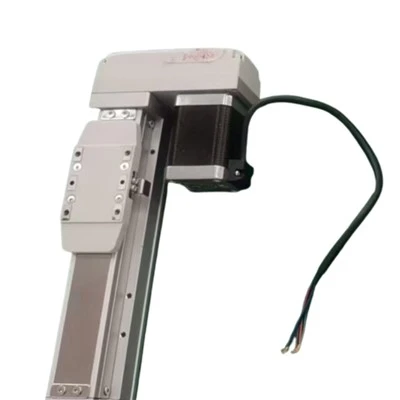
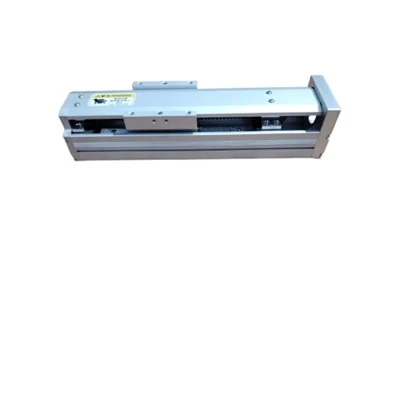
If you’ve ever stood on a factory floor watching a pick-and-place robot lift a circuit board 20 times an hour, or witnessed a CNC mill cut 50 identical aluminum brackets for aerospace parts, you’ve probably relied on a ball screw linear module without even realizing it. These compact assemblies—combining a ball screw, linear guide, and motor mount—are the unsung workhorses of industrial automation, and their single most critical performance metric isn’t speed or load capacity: it’s repeatability. As a supplier of these modules, I get dozens of calls a week from engineers who mix up repeatability with accuracy, and that confusion often leads to wrong part choices, wasted time, and overspent budgets. Today, I want to break down exactly what ball screw linear module repeatability means, why it matters, what factors actually change it, and how we measure it to make sure our customers get the right module for their line. Ball Screw Linear Modules
First, let’s get the definitions straight, because that’s where most mistakes start. Accuracy tells you how close a module moves to a target position—if your target is 100 mm, accuracy is how often the module lands at 100 mm, give or take a tiny error. Repeatability? That’s the consistency of that position when you move to the same point over and over. If you move the module to 100 mm 100 times, repeatability is the range of positions it lands in: if it never goes beyond 100.01 mm or below 99.99 mm, your repeatability is ±0.01 mm. It’s a subtle but huge difference: accuracy can drift with wear, temperature, or load, but repeatability is about how predictable that drift is for a single point. For example, if you’re a pharmaceutical packaging line placing vials into slots, you don’t just need to get the vial close to the slot (that’s accuracy)—you need to place the same vial in the exact same spot, every single run, to avoid jams or broken glass. That’s 100% repeatability territory, and a bad ball screw module can cost you thousands of dollars in downtime if it slips.
Now, let’s talk about why ball screw modules are so consistent at repeatability, especially compared to other linear motion systems. A ball screw works by rolling ball bearings between the screw’s thread and the nut, instead of sliding—so there’s almost no friction. That rolling action means there’s very little hysteresis, or the lag between when you turn the screw and when the nut moves. For context, a lead screw (a cheaper, slimmer alternative) has sliding contact, which creates way more friction and hysteresis: its repeatability might be ±0.1 mm, while a well-built ball screw can hit ±0.002 mm. But here’s the catch: not all ball screw modules are made equal, and even the same module can have different repeatability depending on how it’s set up. Let’s break down the factors that actually change repeatability, because if you’re buying a module, these are the numbers you need to ask about.
First, screw precision class. Ball screws are graded by the ISO 3408 standard, which ranks them from C0 (the highest precision, used for aerospace calibration) to C10 (the lowest, used for cheap, low-accuracy applications like toy conveyor belts). A C5 ball screw has a repeatability tolerance of about ±0.01 mm per 300 mm of travel, while a C3 screw is ±0.005 mm. But here’s what most engineers don’t know: the precision class of the screw is just the starting point. The way the module is assembled can make a big difference too. If we mount the screw to the module’s housing with misaligned bearings, that can create extra friction, make the ball bearings bind, and knock your repeatability off by 20-30%—even if you used a perfect C3 screw. That’s why at our facility, we use laser alignment tools to square the screw to the linear guide rails before locking them into place; skip that step, and you’re buying a high-grade screw for a low-grade module.
Next, preload on the ball nut. Preload is the tightness we set between the ball nut and the screw’s thread to eliminate backlash, that tiny “slop” when you reverse direction. Backlash is the enemy of repeatability: if your module has 0.02 mm of backlash, every time you move from forward to reverse, you’ll have a 0.02 mm lag, which throws off your position consistency. But preload is a balancing act. Too little preload, and you still have backlash; too much preload, and you increase friction and wear, which can actually lower repeatability over time. For standard industrial modules used in packaging and material handling, we set medium preload (about 10-15% of the screw’s dynamic load capacity), which gives us a repeatability of ±0.005 mm. For high-precision applications like semiconductor testing, we use ultra-preload nuts, which cut repeatability to ±0.002 mm, but add a slight increase in friction that’s worth it for those use cases.
Then there’s the effect of load and travel length. You might be surprised to learn that repeatability isn’t a fixed number for a module—it changes based on how much weight you’re moving and how far you’re traveling. If you’re moving a 1 kg load over 100 mm of travel, your repeatability will be way more consistent than if you’re moving a 100 kg load over 1,000 mm. That’s because heavier loads cause the screw to deflect slightly under load, and longer travel means more opportunities for tiny errors to add up. For example, a 2 m ball screw can deflect up to 0.5 mm under a 500 kg load, which adds to the position error each time you move the nut along the screw. At our company, we calculate repeatability for every module based on the customer’s expected load and travel length, not just the screw’s base rating. If a customer tells us they need repeatability for a 500 mm travel with a 300 kg load, we’ll adjust the support bearings on the ends of the screw (adding a thrust bearing to reduce deflection) to make sure the repeatability stays within their required tolerance.
Wear over time is another big one, especially for customers who use their modules 24/7, like automotive assembly lines. Ball screw modules are designed to be durable, but every time the ball bearings roll through the nut, there’s tiny wear on the screw’s threads. Over 10 million cycles, that wear can add up, increasing backlash and lowering repeatability. That’s why we offer hardened steel screws as a standard option: they’re heat-treated to HRC 58, which is way more resistant to wear than standard mild steel, so their repeatability stays consistent for up to 50 million cycles. We also use sealed ball nuts with lubrication ports: regular lubrication reduces friction and wear, so customers should follow our maintenance schedule (every 6 months for heavy use) to keep their repeatability where it needs to be. We recently had a customer in the automotive industry who switched from a cheaper module to ours; after 2 years of running 20 hours a day, their repeatability only dropped by 0.001 mm, while their old module had already lost 0.01 mm in 6 months. That’s the kind of consistency we build into every unit.
Now, how do we measure repeatability? It’s not just guessing—there are standardized tests to make sure our numbers are accurate. We use a laser interferometer, the same tool used to calibrate CNC machines, to measure the module’s position thousands of times over a 1,000 mm travel range. We move the module to 100 different points, 10 times each, and calculate the difference between the highest and lowest position for each point. The repeatability value is the average of those differences, with a 95% confidence interval (meaning 95 out of 100 times, the module will stay within that tolerance). For example, if we test a module and get a range of 0.003 to 0.007 mm over all 100 points, its repeatability is ±0.002 mm. We also test at different loads: we add a 500 kg load to the carriage and repeat the test, to make sure the repeatability doesn’t drop too much under actual working conditions. All of our modules come with a test report that includes this data, so customers know exactly what to expect when they install it.
Wait, let’s clear up a common myth: a lot of people think ball screw modules have the same repeatability as linear motors, but that’s not true for most applications. Linear motors have no contact, so their repeatability can be as low as ±0.001 mm, but they’re way more expensive, draw more power, and are less tolerant of heavy loads. For 90% of industrial applications—packaging, CNC, material handling, 3D printing—a ball screw module’s repeatability of ±0.002 to ±0.01 mm is more than enough, and way more cost-effective than a linear motor. That’s why we work with engineers to match the repeatability to their specific need: if you’re printing a prototype part, you don’t need C0 precision, so a standard C5 module will save you 30% on costs. If you’re placing microchips on a circuit board, you need that ultra-precise C3 module with ±0.002 mm repeatability.
I want to share a recent example that shows why this matters. A customer in the medical device industry reached out to us a few months ago. They were using a ball screw module to assemble insulin pens, placing tiny 2 mm plastic caps onto the pen barrels. Their old module had a repeatability of ±0.02 mm, which meant 1 in 50 pens had caps that were misaligned, leading to a $10,000 monthly scrap cost. They came to us asking for a module with a repeatability of less than ±0.005 mm. We recommended a module with a C3 ball screw, medium preload, and hardened steel screw, and after installing it, their scrap rate dropped to less than 1 in 1,000 pens, saving them over $8,000 a month. That’s the difference between understanding repeatability and getting it right, versus guessing.
Now, if you’re out shopping for a ball screw linear module, what questions should you ask the supplier to make sure you get the right repeatability? First, ask for the ISO 3408 precision class of the screw—don’t let them just say “high precision.” Second, ask for the repeatability tolerance at your expected travel length and load. A module that works great at 100 mm travel might not cut it at 1,000 mm. Third, ask about preload: what level do they set, and how does that affect backlash? Fourth, ask for a test report with actual measured repeatability values, not just advertised numbers. At our company, we’re transparent about all of this—we don’t hide behind vague claims like “industry-leading precision” because we know repeatability is a concrete number that makes a real difference to your bottom line.
At the end of the day, repeatability is the backbone of any automated line. It’s the reason you can run the same product 24 hours a day, 7 days a week, without stopping to fix misaligned parts. As a supplier, our job isn’t just to sell a module—it’s to help you pick the one with the right repeatability for your application, so you can be productive, reduce downtime, and keep costs low. If you’re tired of modules that slip, have inconsistent placement, or wear out too fast, let’s connect to talk through your needs. Whether you’re building a packaging line, a CNC machine, or a medical device assembly system, we can provide a ball screw linear module that meets your exact repeatability requirements.
It is also very important to take care of your ball screw module to maintain repeatability over time. Regular cleaning of the rail and screw, proper lubrication with the correct type of grease or oil, and avoiding overloading the module beyond its rated capacity will all help preserve its precision. We provide a maintenance guide with every module we sell, and our technical support team is available to answer any questions you have about upkeep. We also offer extended warranty options for customers who run high-cycle applications, so you can have peace of mind that your module will perform consistently for years to come.
If you would like to discuss your specific linear motion needs, including required repeatability, load, travel length, and budget, please reach out to our sales team to arrange a consultation. We are happy to provide custom solutions tailored to your unique application.
Rear Testing Production Line References
- ISO 3408-1:2018, Ball screws — Part 1: Vocabulary and designation
- Bolton, W. (2015). Mechatronics: Electronic Control Systems in Mechanical and Electrical Engineering (5th ed.). Pearson Education Limited.
- Oberg, E., Jones, F. D., Horton, H. L., & Ryffel, H. H. (2020). Machinery’s Handbook (31st ed.). Industrial Press, Inc.
- Smith, D. J. (2018). Reliability, Maintainability, and Risk: Practical Methods for Engineers (8th ed.). CRC Press.
- American National Standards Institute (ANSI)/ASME B5.4-2017, Test Code for Linear Motion Ball Screw Assemblies.
Yangning (Xiamen) Intelligent Technology Co., Ltd.
With abundant experience, we are one of the most professional ball screw linear modules manufacturers in China. As we have world-leading production equipment and strong manufacturing capabilities, we warmly welcome you to buy bulk advanced ball screw linear modules from our factory. Customized orders are welcome.
Address: Room 307-2, No.15 Duiying Road, Software Park Phase III, Torch Hi-Tech Zone, Xiamen, Fujian, China
E-mail: mia@ynautos.com
WebSite: https://www.ynautos.com/
